
Sharing of Lessons of the Belfast / Good Friday Agreement in Manila
January 22nd 2026
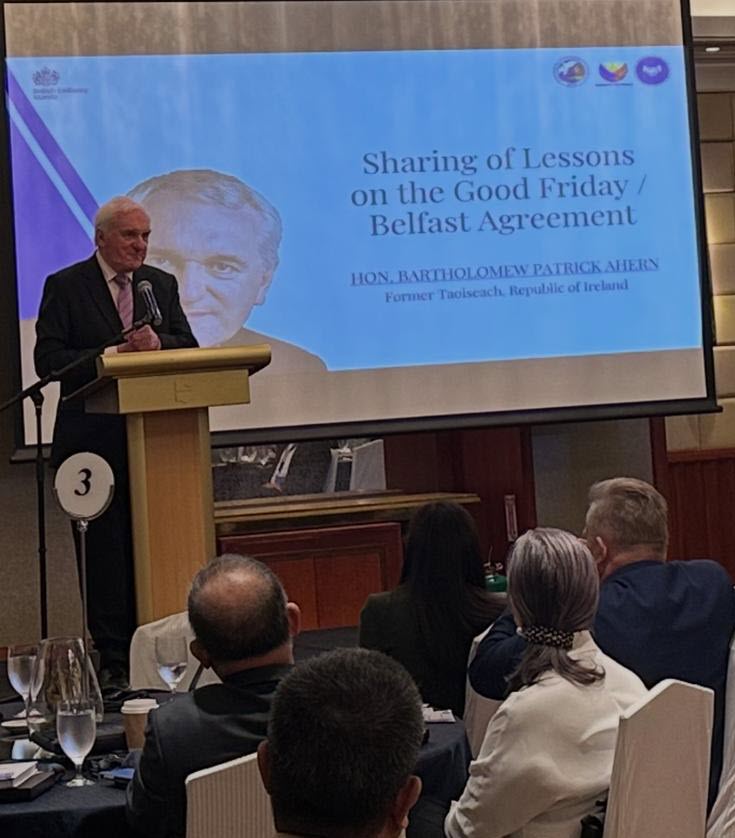
Madame Secretary of Foreign Affairs, Maria Theresa Lazaro, Mr Secretary Carlito Galvez Jr., my good friend, Lord Jack McConnell, Ambassador Sarah Hulton, friends, it is a great honour to be with you today, and a great honour to be here in the Philippines. Thank you for the invitation to speak on the lessons learned from the Good Friday Agreement, which shares a lot of similarities with the Comprehensive Agreement on the Bangsamoro. I want to say from the outset that every peace process is different. History, politics, culture and identity shape how every conflict unfolds, but there are some similarities that tend to be common in many contexts.
The Good Friday Agreement signed between Ireland and the UK in 1998 brought an end to three decades of violence on the island of Ireland. It didn’t solve every problem on our island; our peace process has not been perfect, and we’re still reckoning with our past today, but it did create the political and institutional architecture that allowed conflict to move definitively away from the violence to the democratic arena and embraced the idea of parity of esteem and the principle of consent.
It’s important to state that there have been several further developments of the Agreement, addressing other issues which were not comprehensively covered in the Good Friday Agreement. Implementing the Good Friday agreement and subsequent agreements is very much an ongoing process, which is something I think that you understand in this context as well.
I have been lucky enough to spend the last few days both here in Manila and in the BARMM region, where I got to meet your political leaders and former combatants to discuss the lessons we share from our respective peace processes. There are a few topics that struck a chord with me as being particularly relevant to the Filipino context.
One of the most sensitive and misunderstood elements of the Irish peace process was decommissioning. In Northern Ireland, decommissioning ultimately came to be framed, not as a pre-condition to participation in talks, but as a necessary outcome. Decommissioning did not happen until 11 years of the first ceasefire and several years after the Good Friday Agreement was agreed and the key political issues had been settled. What was critical was that decommissioning wasn’t treated as a purely technical or security exercise. Sequencing and language were paramount and had to be very carefully considered. A set of confidence building measures assisted the decommissioning, including the release of prisoners on license, withdrawal of the British army and dismantling of security infrastructure, and fundamental reforms to governance, policing and justice.
We had made a number of attempts to advance decommissioning in Northern Ireland, and there were different views on how this should be achieved. In the end, progress could only be made when we decoupled decommissioning from humiliation or victory narratives, and instead framed it as part of a reciprocal political journey.
Imaginative use of language was important here, we argued for the guns to fall silent through the ceasefires, were then “put beyond reach” during the negotiations, and – finally – “beyond use”, with international verification. It was still hugely sensitive, requiring international engagement, careful wording to avoid the impression of ‘surrender’, and sequencing with broader steps.
An Independent International Commission chaired by Canadian General John de Chastelain was set up to oversee and verify the decommissioning process. This Commission provided a trusted, independent third-party verification mechanism which reassured all parties that weapons were in fact being decommissioned, while avoiding any scenes which might be considered humiliating. Fundamentally, the leadership of the Republican movement was able to persuade its members that decommissioning was a means by which their political objectives could be advanced.
Policing was another difficult question for us in Northern Ireland, and this question taught us that peace cannot endure unless the institutions are trusted by and accountable to all citizens. Before the Agreement, the member of the Royal Ulster Constabulary were largely drawn from the Protestant / Unionist community, and it was seen by many in the Catholic / Republican community as a vehicle for discrimination.
Eventual reform of the police service was realised through the establishment of an Independent Commission on Policing, a Good Friday Agreement commitment
It identified a set of core 6 principles to underpin policing and represented what the new Police Service should aspire to be:
- Be professional, effective and efficient;
- Be fair and impartial;
- Be free from partisan political control;
- Be accountable, both under the law for its actions and to the community it serves;
- Be representative of the society it polices;
- Operate within a coherent and co-operative criminal justice system.
These principles are profoundly important and each word, each concept matters. For example a police service could be effective and efficient but not impartial, discriminating in the use of force. It was important that the police force became a police service, demilitarised and put at the service of communities.
As circumstances permitted the army disappeared from the streets; the police name was changed, they got new uniforms, new livery for vehicles, a reduction in the use of long arms and other military equipment, and increase in alternative methods of dealing with dangerous situations, ultimately leaving officers armed, normally, only with handguns, batons, CS spray and tasers. It was important that the make up of the force changed, with a strong drive to ensure that 50% of all new recruits came from the nationalist community as they were severely underrepresented in the previous Police Force.
Finally, there was a programme of normalisation of police premises and a development of modern policing policies and practices, and the removal of many military buildings etc. Changes were both operational and symbolic, which played a significant role in rebuilding community trust in the police.
Underlying any peace process is of course the political architecture, which addresses the root causes of violence. Underpinning the Good Friday Agreement was the idea that conflict had persisted for thirty years, not only because of violence, but because sections of society felt excluded, unrepresented and unable to pursue their aspirations through peaceful means. Something I’ve taken away from the various discussions here over the last number of days, is that despite the difficulties you might be facing in the implementation of normalisation here in the Philippines, all the parties still want this process to move forward. But in order for that to happen, I believe that they need to talk to one another. Dialogue remains our most vital tool when faced with deadlock.
I look forward to learning more about the Bangsamoro, and I am very grateful to have been given the opportunity to meet your people and to see this beautiful country.
